What goes into a semiconductor research collection?
Buyers look for records that link a cause to a measured effect across many runs. The most useful are:
- Process recipes and run records from MES, with tool, chamber and lot history
- Inline metrology and SPC data such as film thickness, CD, overlay and sheet resistance
- Wafer maps, defect inspection and yield analyses
- Failure analysis reports with root cause and corrective action
- Characterization and reliability tests for devices and materials
- Simulation compared with silicon, such as TCAD runs checked against measurements
Years of linked runs are worth more than a recent snapshot. See what qualifies for semiconductor companies.
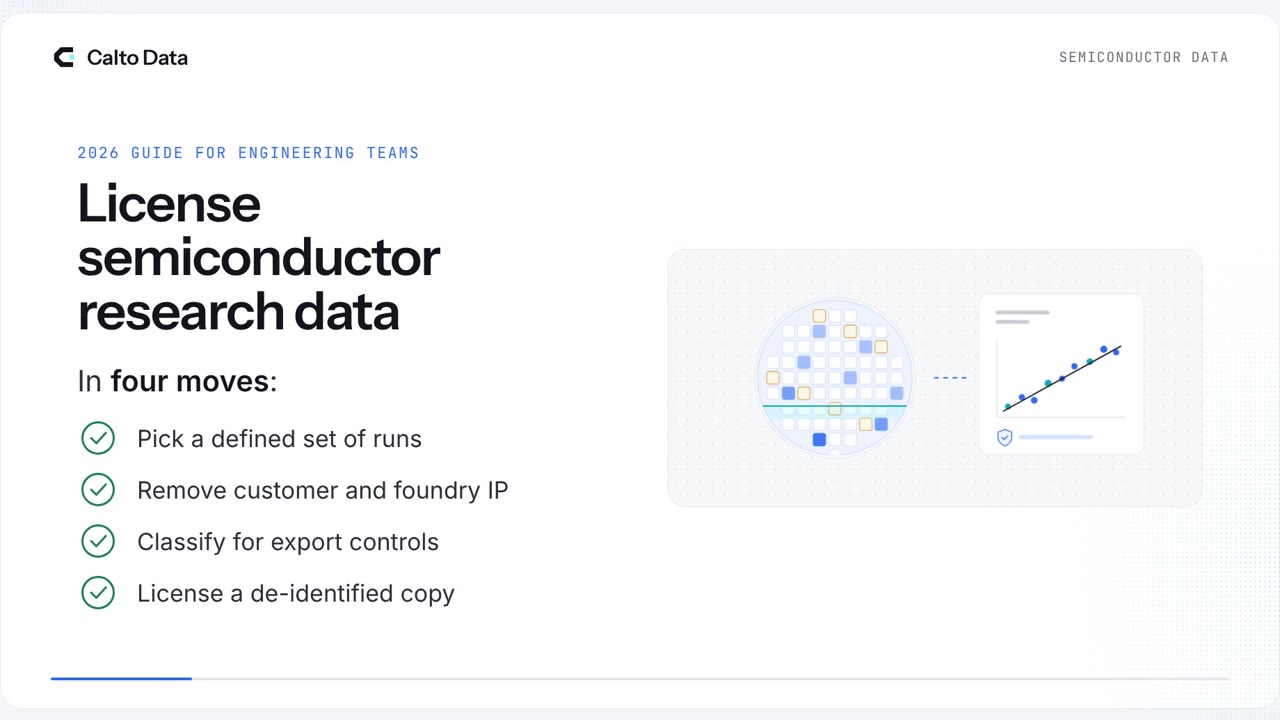
How to license a collection, step by step
- Inventory your systems (MES, yield management, LIMS, electronic lab notebooks and failure analysis databases) and the years each covers.
- Pick one scope, such as a process module, a device family or a materials program.
- Clear ownership. Exclude customer recipes, foundry design-kit data, joint-development work and anything under restricted funding terms.
- Classify for export controls before any data leaves the company; see export controls and AI data licensing.
- De-identify customer names, product codes, people and, where needed, tool and site identifiers.
- Describe the collection (run counts, years, parameters, formats) so buyers can judge it without seeing files.
- Agree the licence; see what the agreement should include.
Where can semiconductor companies buy access to technical studies?
Published papers and conference proceedings describe methods, but the run-level data behind them is rarely sold in public. Detailed technical studies, such as process windows, failure analyses and reliability results, are licensed privately from the fabs, equipment makers, materials suppliers and test labs that produced them.
These deals are usually arranged through an introduction, under a licence that limits use and can keep the source company anonymous. Calto Data introduces companies that hold technical records to the AI and engineering teams looking for them: tell us what you need.
How to protect process know-how
License only what you are comfortable sharing. Many teams start with older process generations, finished programs or aggregated results, and keep current recipes out. The contract should ban onward sharing and attempts to identify customers, and require deletion at the end of the term.
| Licence type | What the buyer can do |
|---|---|
| Training | Train models on the copy for agreed uses |
| Evaluation only | Test models against the data, with no training |
| Exclusive | Sole access in a field or for a period, usually at a higher fee |
Is your collection a fit?
Calto Data’s free two-minute check tells you whether your records match what AI buyers are asking for. No files are uploaded.
Frequently asked questions
What do AI companies use semiconductor data for?
Training and testing models for process optimisation, defect classification, yield prediction, materials discovery and failure analysis.
Can equipment makers and materials suppliers license data?
Yes, if they own the records. Tool performance, maintenance, refurbishment and materials test histories can all qualify once customer data is removed.
How is the price set?
By negotiation. Volume, the years covered, how well results are linked to settings, and the rights granted all move the price.